
NCERT Solutions for Class 11th Biology
Chapter 6 ANATOMY OF FLOWERING PLANTS
Question 1: State the location and function of different types of meristem.
Answer Meristems are specialised regions of plant growth. The meristems mark the regions where active cell division and rapid division of cells take place. Meristems are of three types depending on their location.
Apical meristem
It is present at the root apex and the shoot apex.The shoot apical meristem is present at the tip of the shoots and its active division results in the elongation of the stem and formation of new leaves. The root apical meristem helps in root elongation.
Intercalary meristem
It is present between the masses of mature tissues present at the bases of the leaves of grasses. It helps in the regeneration of grasses after they have been grazed by herbivores. Since the intercalary meristem and the apical meristem appear early in a plant’s life, they constitute the primary meristem.
Lateral meristem
It appears in the mature tissues of roots and shoots. It is called the secondary meristem as it appears later in a plant’s life. It helps in adding secondary tissues to the plant body and in increasing the girth of plants. Examples include fascicular cambium, interfascicular cambiumQuestion 9: Name the three basic tissue systems in the flowering plants. Give the tissue names under each system.
Answer Meristems are specialised regions of plant growth. The meristems mark the regions where active cell division and rapid division of cells take place. Meristems are of three types depending on their location.
Apical meristem
It is present at the root apex and the shoot apex.The shoot apical meristem is present at the tip of the shoots and its active division results in the elongation of the stem and formation of new leaves. The root apical meristem helps in root elongation.
Intercalary meristem
It is present between the masses of mature tissues present at the bases of the leaves of grasses. It helps in the regeneration of grasses after they have been grazed by herbivores. Since the intercalary meristem and the apical meristem appear early in a plant’s life, they constitute the primary meristem.
Lateral meristem
It appears in the mature tissues of roots and shoots. It is called the secondary meristem as it appears later in a plant’s life. It helps in adding secondary tissues to the plant body and in increasing the girth of plants. Examples include fascicular cambium, interfascicular cambiumQuestion 9: Name the three basic tissue systems in the flowering plants. Give the tissue names under each system.
Answer

Question 10: How is the study of plant anatomy useful to us?
Answer The study of plant anatomy helps us to understand the structural adaptations of plants with respect to diverse environmental conditions. It also helps us to distinguish between monocots, dicots, and gymnosperms. Such a study is linked to plant physiology. Hence, it helps in the improvement of food crops. The study of plant-structure allows us to predict the strength of wood. This is useful in utilising it to its potential. The study of various plant fibres such as jute, flax, etc., helps in their commercial exploitation.
Answer The study of plant anatomy helps us to understand the structural adaptations of plants with respect to diverse environmental conditions. It also helps us to distinguish between monocots, dicots, and gymnosperms. Such a study is linked to plant physiology. Hence, it helps in the improvement of food crops. The study of plant-structure allows us to predict the strength of wood. This is useful in utilising it to its potential. The study of various plant fibres such as jute, flax, etc., helps in their commercial exploitation.
Question 11: What is periderm? How does periderm formation take place in dicot stem?
Answer Periderm is composed of the phellogen, phellem, and phelloderm.
During secondary growth, the outer epidermal layer and the cortical layer are broken because of the cambium. To replace them, the cells of the cortex turn meristematic, giving rise to cork cambium or phellogen. It is composed of thin-walled, narrow and rectangular cells.
Phellogen cuts off cells on its either side. The cells cut off toward the outside give rise to the phellem or cork. The suberin deposits in its cell wall make it impervious to water. The inner cells give rise to the secondary cortex or phelloderm. The secondary cortex is parenchymatous.
Answer Periderm is composed of the phellogen, phellem, and phelloderm.
During secondary growth, the outer epidermal layer and the cortical layer are broken because of the cambium. To replace them, the cells of the cortex turn meristematic, giving rise to cork cambium or phellogen. It is composed of thin-walled, narrow and rectangular cells.
Phellogen cuts off cells on its either side. The cells cut off toward the outside give rise to the phellem or cork. The suberin deposits in its cell wall make it impervious to water. The inner cells give rise to the secondary cortex or phelloderm. The secondary cortex is parenchymatous.
Question 12: Describe the internal structure of a dorsiventral leaf with the help of labelled diagrams.
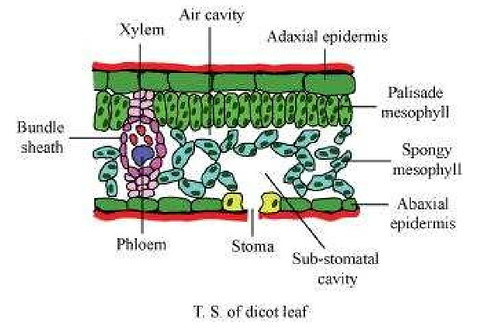
Answer Dorsiventral leaves are found in dicots. The vertical section of a dorsiventral leaf contains three distinct parts.
[1] Epidermis:
Epidermis is present on both the upper surface (adaxial epidermis) and the lower surface (abaxial epidermis). The epidermis on the outside is covered with a thick cuticle. Abaxial epidermis bears more stomata than the adaxial epidermis.
[2] Mesophyll:
Mesophyll is a tissue of the leaf present between the adaxial and abaxial epidermises. It is differentiated into the palisade parenchyma (composed of tall, compactly-placed cells) and the spongy parenchyma (comprising oval or round, loosely-arranged cells with inter cellular spaces). Mesophyll contains the chloroplasts which perform the function of photosynthesis.
[3] Vascular system:
The vascular bundles present in leaves are conjoint and closed. They are surrounded by thick layers of bundle-sheath cells.
Answer Dorsiventral leaves are found in dicots. The vertical section of a dorsiventral leaf contains three distinct parts.
[1] Epidermis:
Epidermis is present on both the upper surface (adaxial epidermis) and the lower surface (abaxial epidermis). The epidermis on the outside is covered with a thick cuticle. Abaxial epidermis bears more stomata than the adaxial epidermis.
[2] Mesophyll:
Mesophyll is a tissue of the leaf present between the adaxial and abaxial epidermises. It is differentiated into the palisade parenchyma (composed of tall, compactly-placed cells) and the spongy parenchyma (comprising oval or round, loosely-arranged cells with inter cellular spaces). Mesophyll contains the chloroplasts which perform the function of photosynthesis.
[3] Vascular system:
The vascular bundles present in leaves are conjoint and closed. They are surrounded by thick layers of bundle-sheath cells.
DOWNLOAD OUR APP
, and cork cambium
Question 2: Cork cambium forms tissues that form the cork. Do you agree with this statement? Explain.
Answer When secondary growth occurs in the dicot stem and root, the epidermal layer gets broken. There is a need to replace the outer epidermal cells for providing protection to the stem and root from infections. Therefore, the cork cambium develops from the cortical region. It is also known as phellogen and is composed of thin-walled rectangular cells. It cuts off cells toward both sides. The cells on the outer side get differentiated into the cork or phellem, while the cells on the inside give rise to the secondary cortex or phelloderm. The cork is impervious to water, but allows gaseous exchange through the lenticels. Phellogen, phellem, and phelloderm together constitute the periderm.
Answer When secondary growth occurs in the dicot stem and root, the epidermal layer gets broken. There is a need to replace the outer epidermal cells for providing protection to the stem and root from infections. Therefore, the cork cambium develops from the cortical region. It is also known as phellogen and is composed of thin-walled rectangular cells. It cuts off cells toward both sides. The cells on the outer side get differentiated into the cork or phellem, while the cells on the inside give rise to the secondary cortex or phelloderm. The cork is impervious to water, but allows gaseous exchange through the lenticels. Phellogen, phellem, and phelloderm together constitute the periderm.
Question 3: Explain the process of secondary growth in stems of woody angiosperm with help of schematic diagrams. What is the significance?
Answer In woody dicots, the strip of cambium present between the primary xylem and phloem is called the interfascicular cambium. The interfascicular cambium is formed from the cells of the medullary rays adjoining the interfascicular cambium. This results in the formation of a continuous cambium ring. The cambium cuts off new cells toward its either sides. The cells present toward the outside differentiate into the secondary phloem, while the cells cut off toward the pith give rise to the secondary xylem. The amount of the secondary xylem produced is more than that of the secondary phloem.
![]()
Answer In woody dicots, the strip of cambium present between the primary xylem and phloem is called the interfascicular cambium. The interfascicular cambium is formed from the cells of the medullary rays adjoining the interfascicular cambium. This results in the formation of a continuous cambium ring. The cambium cuts off new cells toward its either sides. The cells present toward the outside differentiate into the secondary phloem, while the cells cut off toward the pith give rise to the secondary xylem. The amount of the secondary xylem produced is more than that of the secondary phloem.
The secondary growth in plants increases the girth of plants, increases the amount of water and nutrients to support the growing number of leaves, and also provides support to plants.
Question 4: Draw illustrations to bring out anatomical difference between
(a) Monocot root and dicot root
(b) Monocot stem and dicot stem
Answer


(a) Monocot root and dicot root
(b) Monocot stem and dicot stem
Answer
DOWNLOAD OUR APP
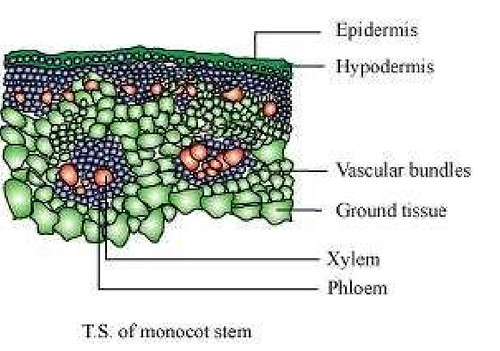
5.Cut a transverse section of young stem of a plant from your school garden and observe it under the microscope. How would you ascertain whether it is a monocot stem or a dicot stem ? Give reasons.
Soln. Vascular bundles in dicot stem are arranged in a ring whereas in monocot stem vascular bundles are scattered throughout the ground tissue. On the basis of arrangement of vascular bundles it can be ascertained
whether the young stem is dicot or monocot. Besides undifferentiated ground tissue, sclerenchymatous hypodermis, oval or circular vascular bundles with Y shaped xylem are other differentiating features of monocot stem.
Soln. Vascular bundles in dicot stem are arranged in a ring whereas in monocot stem vascular bundles are scattered throughout the ground tissue. On the basis of arrangement of vascular bundles it can be ascertained
whether the young stem is dicot or monocot. Besides undifferentiated ground tissue, sclerenchymatous hypodermis, oval or circular vascular bundles with Y shaped xylem are other differentiating features of monocot stem.
6.The transverse section of a plant material shows the following anatomical features – (a) the vascular bundles are conjoint, scattered and surrounded by a sclerenchymatous bundle sheath, (b) phloem parenchyma is absent. What will you identify it as?
Soln. The plant material is identified as monocot stem.
Soln. The plant material is identified as monocot stem.
7.Why are xylem and phloem called complex tissues?
Soln. A group of different types of cells which perform common function is called complex tissue. Xylem and phloem are called complex tissues as all cells that work as a unit for a common function have different structural organisation. Xylem has four types of cells-tracheids, vessels, xylem parenchyma and xylem fibres. Phloem consists of sieve tube elements, companion cells, phloem parenchyma and phloem fibres. Xylem is associated with conduction of water and minerals from roots to top of plants and phloem is responsible for transport of organic food.
Soln. A group of different types of cells which perform common function is called complex tissue. Xylem and phloem are called complex tissues as all cells that work as a unit for a common function have different structural organisation. Xylem has four types of cells-tracheids, vessels, xylem parenchyma and xylem fibres. Phloem consists of sieve tube elements, companion cells, phloem parenchyma and phloem fibres. Xylem is associated with conduction of water and minerals from roots to top of plants and phloem is responsible for transport of organic food.
8.What is stomatal apparatus? Explain the structure of stomata with a labelled diagram.
Soln.Stomata are structures present in the epidermis of leaves. Stomata regulate the process of transpiration and gaseous exchange. Each stoma is composed*of two bean shaped cells known as guard cells which enclose stomatal pore. The outer walls of guard cells (away from the stomatal pore) are thin and the inner walls (towards the stomatal pore) are highly thickened. The guard cells possess chloroplasts and regulate the opening and closing of stomata. Sometimes, a few epidermal cells, in the vicinity of the guard cells become specialised in their shape and size and are known as subsidiary cells. The stomatal aperture, guard cells and the surrounding subsidiary cells are together called stomatal apparatus.

Soln.Stomata are structures present in the epidermis of leaves. Stomata regulate the process of transpiration and gaseous exchange. Each stoma is composed*of two bean shaped cells known as guard cells which enclose stomatal pore. The outer walls of guard cells (away from the stomatal pore) are thin and the inner walls (towards the stomatal pore) are highly thickened. The guard cells possess chloroplasts and regulate the opening and closing of stomata. Sometimes, a few epidermal cells, in the vicinity of the guard cells become specialised in their shape and size and are known as subsidiary cells. The stomatal aperture, guard cells and the surrounding subsidiary cells are together called stomatal apparatus.
DOWNLOAD OUR APP
LIKE US ON FACEBOOK |
Comments
Post a Comment