
NCERT Solutions for Class 11th BIOLOGY
Class 11 BIOLOGY SOLUTION
Chapter 11 Locomotion And Movement
1. Draw the diagram of a sarcomere of skeletal muscle showing different regions.
Solution:

Solution:
2. Define sliding filament theory of muscle contraction.
Solution: According to sliding filament theory of muscle contraction, the actin and myosin filaments slide past each other with the help of cross-bridges to reduce the length of the sarcomeres.
Solution: According to sliding filament theory of muscle contraction, the actin and myosin filaments slide past each other with the help of cross-bridges to reduce the length of the sarcomeres.
3. Describe the important steps in muscle contraction.
Solution: Mechanism of muscle contraction is explainei by sliding filament theory which states that contraction of a muscle fibre takes place by the sliding of the thin filaments over the th’ ck filaments. As a nerve impulse reaches the terminal end of the axon, synaptic vesicles fuse with the axon membrane and release a chemical transmitter, acetylcholine and binds to receptor sites of the motor end plate. When depolarization of the motor end plate reaches a certain level, it creates an action potential. An action potential (impulse) passes from the motor end plate over the sarcolemma and then into the T-tubules and sarcoplasmic reticulum and stimulates the sarcoplasmic reticulum to release calcium ions into the sarcoplasm. The calcium ions bind to troponin causing a change in its shape and position. This in turn alters shape and the position of tropomyosin, to which troponin binds. This shift exposes the active sites on the F-actin molecules. Myosin cross-bridges are then able to bind to these active sites. The heads of myosin molecules project laterally from thick myofilaments towards the surrounding thin myofilaments. These heads are called cross bridges. The head of each myosin molecule contains an enzyme mysoin ATPase. In the presence of myosin ATPase,Ca++ and Mg++ ions, ATP breaks down into ADP and inorganic phosphate, releasing energy in the head.
Energy from ATP causes energized myosin cross bridges to bind to actin.

The energized cross-bridges move, causing thin myofilaments to slide along the thick myofilaments.
Solution: Mechanism of muscle contraction is explainei by sliding filament theory which states that contraction of a muscle fibre takes place by the sliding of the thin filaments over the th’ ck filaments. As a nerve impulse reaches the terminal end of the axon, synaptic vesicles fuse with the axon membrane and release a chemical transmitter, acetylcholine and binds to receptor sites of the motor end plate. When depolarization of the motor end plate reaches a certain level, it creates an action potential. An action potential (impulse) passes from the motor end plate over the sarcolemma and then into the T-tubules and sarcoplasmic reticulum and stimulates the sarcoplasmic reticulum to release calcium ions into the sarcoplasm. The calcium ions bind to troponin causing a change in its shape and position. This in turn alters shape and the position of tropomyosin, to which troponin binds. This shift exposes the active sites on the F-actin molecules. Myosin cross-bridges are then able to bind to these active sites. The heads of myosin molecules project laterally from thick myofilaments towards the surrounding thin myofilaments. These heads are called cross bridges. The head of each myosin molecule contains an enzyme mysoin ATPase. In the presence of myosin ATPase,Ca++ and Mg++ ions, ATP breaks down into ADP and inorganic phosphate, releasing energy in the head.
Energy from ATP causes energized myosin cross bridges to bind to actin.
The energized cross-bridges move, causing thin myofilaments to slide along the thick myofilaments.
4. Write true or false. If false change the statement so that it is true.
(a) Actin is present in thin filament.
(b) H-zone of striated muscle fibre represents both thick and thin filaments.
(c) Human skeleton has 206 bones.
(d) There are 11 pairs of ribs in man.
(e) Sternum is present on the ventral side of the body.
Solution: (a) True
(b) False – H-Zone of striated muscle fibres represents only thick filaments.
(c) True
(d) False – There are 12 pairs of ribs in man.
(e) True
(a) Actin is present in thin filament.
(b) H-zone of striated muscle fibre represents both thick and thin filaments.
(c) Human skeleton has 206 bones.
(d) There are 11 pairs of ribs in man.
(e) Sternum is present on the ventral side of the body.
Solution: (a) True
(b) False – H-Zone of striated muscle fibres represents only thick filaments.
(c) True
(d) False – There are 12 pairs of ribs in man.
(e) True
5. Write the differences between:
(a) Actin and Myosin
(b) Red and White muscles
(c) Pectoral and Pelvic girdle
Solution: (a) Actin filaments and myosin filaments can be differentiated as follows:

(b) Differences between red muscle fibres and white muscle fibres are given in the following table:


(c) Differences between pectoral and pelvic girdles are given in the following table:

Class 11 BIOLOGY SOLUTION(a) Actin and Myosin
(b) Red and White muscles
(c) Pectoral and Pelvic girdle
Solution: (a) Actin filaments and myosin filaments can be differentiated as follows:
(b) Differences between red muscle fibres and white muscle fibres are given in the following table:
(c) Differences between pectoral and pelvic girdles are given in the following table:
Question 6:
Match Column I with Column II :


Match Column I with Column II :
Question 7: What are the different types of movements exhibited by the cells of human body?
Answer Movement is a characteristic feature of living organisms. The different types of movement exhibited by cells of the human body are:
• Amoeboid movement: Leucocytes present in the blood show amoeboid movement. During tissue damage, these blood cells move from the circulatory system towards the injury site to initiate an immune response.
• Ciliary movement: Reproductive cells such as sperms and ova show ciliary movement. The passage of ova through the fallopian tube towards the uterus is facilitated by this movement.
• Muscular movement: Muscle cells show muscular movement.
Answer Movement is a characteristic feature of living organisms. The different types of movement exhibited by cells of the human body are:
• Amoeboid movement: Leucocytes present in the blood show amoeboid movement. During tissue damage, these blood cells move from the circulatory system towards the injury site to initiate an immune response.
• Ciliary movement: Reproductive cells such as sperms and ova show ciliary movement. The passage of ova through the fallopian tube towards the uterus is facilitated by this movement.
• Muscular movement: Muscle cells show muscular movement.
Question 8: How do you distinguish between a skeletal muscle and a cardiac muscle?
Answer

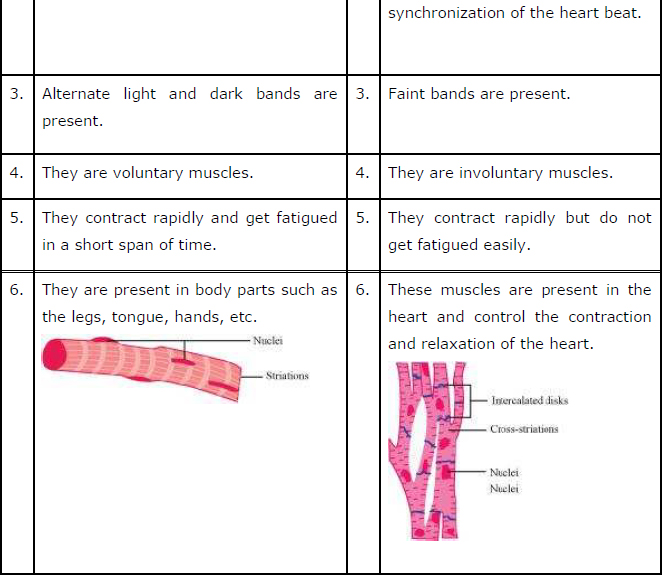
Answer
Question 9: Name the type of joint between the following:-
(a) atlas/axis
(b) carpal/metacarpal of thumb
(c) between phalanges
(d) femur/acetabulum
(e) between cranial bones
(f) between pubic bones in the pelvic girdle
Answer(a) atlas/axis: Pivotal joint
(b) carpal/metacarpal of thumb: Saddle joint
(c) between phalanges: Hinge joint
(d) femur/acetabulum: Ball and socket joint
(e) between cranial bones: Fibrous joint
(f) between pubic bones in the pelvic girdle: Ball and socket joint
(a) atlas/axis
(b) carpal/metacarpal of thumb
(c) between phalanges
(d) femur/acetabulum
(e) between cranial bones
(f) between pubic bones in the pelvic girdle
Answer(a) atlas/axis: Pivotal joint
(b) carpal/metacarpal of thumb: Saddle joint
(c) between phalanges: Hinge joint
(d) femur/acetabulum: Ball and socket joint
(e) between cranial bones: Fibrous joint
(f) between pubic bones in the pelvic girdle: Ball and socket joint
Question 10: Fill in the blank spaces:
(a) All mammals (except a few) have __________ cervical vertebra.
(b) The number of phalanges in each limb of human is __________
(c) Thin filament of myofibril contains 2 ‘F’ actins and two other proteins namely _________ and __________.
(d) In a muscle fibre Ca++ is stored in __________
(e) __________ and __________ pairs of ribs are called floating ribs.
(f) The human cranium is made of __________ bones.
Answer

(a) All mammals (except a few) have __________ cervical vertebra.
(b) The number of phalanges in each limb of human is __________
(c) Thin filament of myofibril contains 2 ‘F’ actins and two other proteins namely _________ and __________.
(d) In a muscle fibre Ca++ is stored in __________
(e) __________ and __________ pairs of ribs are called floating ribs.
(f) The human cranium is made of __________ bones.
Answer
Comments
Post a Comment