
NCERT Solutions for Class 11th BIOLOGY
Class 11 BIOLOGY SOLUTION
Chapter 22 CHEMICAL COORDINATION AND INTEGRATION
1. Define the following:
(a) Exocrine gland,
(b) Endocrine gland,
(c) Hormone.
Solution:
(a) Exocrine gland is a gland that pours its secretion on the surface or into a particular region by means of ducts for performing a metabolic activity, e.g., sebaceous glands, sweat glands, salivary glands and intestinal glands.
(b) Endocrine gland is an isolated gland (separates even from epithelium forming it) which secretes informational molecules or hormones that are poured into venous blood or lymph for reaching the target organ because the gland is not connected with the target organ by any duct. Therefore endocrine gland is also called ductless gland e.g. thyroid gland.
(c) Hormone is a substance that is manu-factured and secreted in very small quantities into the blood stream by an endocrine gland or a specialized nerve cell and regulates the growth or functioning of a specific tissue organ in a distant part of the body e.g insulin.
(a) Exocrine gland,
(b) Endocrine gland,
(c) Hormone.
Solution:
(a) Exocrine gland is a gland that pours its secretion on the surface or into a particular region by means of ducts for performing a metabolic activity, e.g., sebaceous glands, sweat glands, salivary glands and intestinal glands.
(b) Endocrine gland is an isolated gland (separates even from epithelium forming it) which secretes informational molecules or hormones that are poured into venous blood or lymph for reaching the target organ because the gland is not connected with the target organ by any duct. Therefore endocrine gland is also called ductless gland e.g. thyroid gland.
(c) Hormone is a substance that is manu-factured and secreted in very small quantities into the blood stream by an endocrine gland or a specialized nerve cell and regulates the growth or functioning of a specific tissue organ in a distant part of the body e.g insulin.
2. Diagrammatically indicate the location of the various endocrine glands in our body.
Solution:

Solution:
3. List the hormones secreted by the following:
(a) Hypothalamus
(b) Pituitary
(c) Thyroid
(d) Parathyroid
(e) Adrenal
(f) Pancreas
(g) Testis
_____________Class 11 BIOLOGY SOLUTION_____________
(a) Hypothalamus
(b) Pituitary
(c) Thyroid
(d) Parathyroid
(e) Adrenal
(f) Pancreas
(g) Testis
_____________Class 11 BIOLOGY SOLUTION_____________
(h) Ovary
(i) Thymus
(j) Atrium
(k) Kidney
(l) G-l Tract.
Solution:
(a) Two types of hormones are produced by hypothalamus : releasing hormones (that stimulate secretion of pituitary hormones) and inhibiting hormones (that inhibit secretion of pituitary hormones).
These hormones are:
(i) Thymus
(j) Atrium
(k) Kidney
(l) G-l Tract.
Solution:
(a) Two types of hormones are produced by hypothalamus : releasing hormones (that stimulate secretion of pituitary hormones) and inhibiting hormones (that inhibit secretion of pituitary hormones).
These hormones are:
- Thyrotrophin-releasing hormone Adreno-
- corticotrophin-releasing hormone
- Follicle-stimulating hormone-releasing hormone
- Luteinizing hormone-releasing hormone
- Growth hormone-releasing hormone
- Growth inhibiting hormone
- Prolactin releasing hormone
- Prolactin inhibiting hormone
- Melanocyte stimulating hormone¬releasing hormone
- Melanocyte stimulating hormone- inhibiting hormone.
(b) Different parts of pituitary secrete different hormones.
Hormones secreted by anterior lobe of pituitary are:
Hormones secreted by anterior lobe of pituitary are:
- Follicle stimulating hormone
- Luteinizing hormone
- Thyroid stimulating hormone
- Adrenocorticotrophic hormone
- Somatotrophic or Growth hormone
- Prolactin hormone or Luteotrophic hormone.
Middle (intermediate) lobe of pituitary : Melanocyte stimulating hormone.
Posterior lobe of pituitary:
(i) Oxytocin
(ii) Vasopressin or antidiuretic hormone.
(c) Thyroid secretes 3 hormones:
- Thyroxine or tetraiodothyronine
- Triiodothyronine
- Calcitonin.
(d) Parathyroid gland secretes a single hormone called parathormone (PTH) or Collip’s hormone.
(e) Adrenal glands have two regions, namely, outer adrenal cortex and inner adrenal medulla. Both these regions secrete different hormones.
Hormones of adrenal cortex are grouped into three categories:
Hormones of adrenal cortex are grouped into three categories:
- Glucocorticoids, e.g., cortisol
- Mineralocorticoids, e.g., aldosterone
- Sexcorticoids e.g testosterone. Adrenal medulla secretes two hormones
(i) Epinephrine (adrenaline)
(ii)Nor-epinephrine (nor-adrenaline).
(f) Pancreas secretes following hormones:
- Insulin
- Glucagon
- Somatostatin.
(g) Testis secretes androgens such as testosterone.
(h) Ovary secretes:
- Estrogens such as estradiol
- Progesterone
- Relaxin.
(i) Thymus secretes thymosin hormone.
(j) Atrium secretes atrial natriuretic factor (ANF).
(k) Kidney secretes:
(i) Renin (ii) Erythropoetin
(i) Renin (ii) Erythropoetin
(l) G.I. tract secretes :
- Gastrin
- Secretin
- Cholecystokinin
- Enterocrinin
- Duocrinin
- Villikinin.
4. Fill in the blanks:
Hormones Target gland
(a) Hypothalamic hormones ………………..
(b) Thyrotrophin (TSH) ………………..
(c) Corticotrophin (ACH) ………………..
(d) Gonadotrophins (LH, FSH) ………………..
(e) Melanotrophin (MSH) ………………..
Solution:
(a) Pituitary
(b) Thyroid
(c) Adrenal cortex
(d) Gonads -Testes in male and ovaries in female
(e) Skin.
Hormones Target gland
(a) Hypothalamic hormones ………………..
(b) Thyrotrophin (TSH) ………………..
(c) Corticotrophin (ACH) ………………..
(d) Gonadotrophins (LH, FSH) ………………..
(e) Melanotrophin (MSH) ………………..
Solution:
(a) Pituitary
(b) Thyroid
(c) Adrenal cortex
(d) Gonads -Testes in male and ovaries in female
(e) Skin.
Question 5: Write short notes on the functions of the following hormones,
(a) Parathyroid hormone (PTH)
(b) Thyroid hormones
(c) Thymosins
(d) Androgens
(e) Estrogens
(f) Insulin and Glucagon
Answer (a) Parathyroid hormone (PTH) – The parathyroid hormone is secreted by the parathyroid gland. Its main function is to increase the level of calcium in blood. It promotes the reabsorption of calcium from nephrons and also, promotes the absorption of calcium from digested food. Hence, it plays an important role in maintaining calcium balance in the body.
(b) Thyroid hormones – Thyroid hormones such as thyroxine, triiodothyronin, and thyrocalcitonin are secreted by the thyroid gland. Thyroxine maintains the basal metabolic rate of the body and regulates the carbohydrate, fat, and protein metabolism. Water and electrolyte balance is also maintained by thyroid hormones. Thyrocalcitonin or calcitonin lowers calcium level in blood plasma. It plays a significant role in calcium levels along with parathyroid hormone.
(c) Thymosins – Thymosin is secreted by the thymus gland. It plays a major role in protecting the body against infectious agents. It helps in the differentiation of T-lymphocytes and also promotes the reproduction of antibodies. Hence, it provides both cell-mediated and humoral immunity. Thymosins also help in the development of sex glands.
(d) Androgens – The leydig cells of testis produce androgens such as testosterone. Testosterone is a male sex hormone that regulates the development of secondary sex characteristics such as facial hair, hoarse voice, development of reproductive organ, etc. Androgens also regulate the development, maturation, and functions of various male accessory organs such as epididymis and prostate glands. It stimulates spermatogenesis and formation of mature sperms. It also influences male sexual behaviour.
(e) Estrogens- Estrogen is the female sex hormone that controls the development of secondary sex characteristics such as enlargement of breasts and development of female reproductive organs. It plays a role in the development, growth and maturation of female secondary characteristics. It also helps in the development of growing ovarian follicles. It influences female sexual behaviour.
(f) Insulin and glucagon – Glucagon and insulin are secreted by cells of pancreas. They regulate the blood glucose level in the body. α-cells secrete glucagon that maintain a normal blood glucose level in the body, whereas β-cells secrete insulin that regulates the storage of glycogen in the liver.
Function of insulin – Insulin stimulates glycogenesis (conversion of glucose to glycogen). The rapid conversion of glucose from the blood to glycogen in hepatocytes and adipocytes results into a decreased glucose level. Insulin also prevents the formation of glucose from non-carbohydrate substances such as proteins and fats. Hence, it acts as a regulator of carbohydrate metabolism.
Function of glucagon – The main function of the glucagon is to increase the level of glucose when there is a deficiency of glucose in the body. This process is known as glycogenolysis.
(a) Parathyroid hormone (PTH)
(b) Thyroid hormones
(c) Thymosins
(d) Androgens
(e) Estrogens
(f) Insulin and Glucagon
Answer (a) Parathyroid hormone (PTH) – The parathyroid hormone is secreted by the parathyroid gland. Its main function is to increase the level of calcium in blood. It promotes the reabsorption of calcium from nephrons and also, promotes the absorption of calcium from digested food. Hence, it plays an important role in maintaining calcium balance in the body.
(b) Thyroid hormones – Thyroid hormones such as thyroxine, triiodothyronin, and thyrocalcitonin are secreted by the thyroid gland. Thyroxine maintains the basal metabolic rate of the body and regulates the carbohydrate, fat, and protein metabolism. Water and electrolyte balance is also maintained by thyroid hormones. Thyrocalcitonin or calcitonin lowers calcium level in blood plasma. It plays a significant role in calcium levels along with parathyroid hormone.
(c) Thymosins – Thymosin is secreted by the thymus gland. It plays a major role in protecting the body against infectious agents. It helps in the differentiation of T-lymphocytes and also promotes the reproduction of antibodies. Hence, it provides both cell-mediated and humoral immunity. Thymosins also help in the development of sex glands.
(d) Androgens – The leydig cells of testis produce androgens such as testosterone. Testosterone is a male sex hormone that regulates the development of secondary sex characteristics such as facial hair, hoarse voice, development of reproductive organ, etc. Androgens also regulate the development, maturation, and functions of various male accessory organs such as epididymis and prostate glands. It stimulates spermatogenesis and formation of mature sperms. It also influences male sexual behaviour.
(e) Estrogens- Estrogen is the female sex hormone that controls the development of secondary sex characteristics such as enlargement of breasts and development of female reproductive organs. It plays a role in the development, growth and maturation of female secondary characteristics. It also helps in the development of growing ovarian follicles. It influences female sexual behaviour.
(f) Insulin and glucagon – Glucagon and insulin are secreted by cells of pancreas. They regulate the blood glucose level in the body. α-cells secrete glucagon that maintain a normal blood glucose level in the body, whereas β-cells secrete insulin that regulates the storage of glycogen in the liver.
Function of insulin – Insulin stimulates glycogenesis (conversion of glucose to glycogen). The rapid conversion of glucose from the blood to glycogen in hepatocytes and adipocytes results into a decreased glucose level. Insulin also prevents the formation of glucose from non-carbohydrate substances such as proteins and fats. Hence, it acts as a regulator of carbohydrate metabolism.
Function of glucagon – The main function of the glucagon is to increase the level of glucose when there is a deficiency of glucose in the body. This process is known as glycogenolysis.
Question 6: Give example(s) of:
(a) Hyperglycemic hormone and hypoglycemic hormone
(b) Hypercalcemic hormone
(c) Gonadotrophic hormones
(d) Progestational hormone
(e) Blood pressure lowering hormone
(f) Androgens and estrogens
Answer (a) Hyperglycemic hormone and hypoglycemic hormone: Hyperglycemic hormone is glucagon, while hypoglycemic hormone is insulin.
(b) Hypercalcemic hormone: Parathyroid hormone (PTH) is hypercalcemic hormone.
(c) Gonadotrophic hormones: Luteinizing hormone and follicle stimulating hormones are examples of gonadotrophic hormone.
(d) Progestational hormone: Progesterone is a progestational hormone.
(e) Blood pressure lowering hormone: Nor-adrenalin is a blood pressure lowering hormone.
(f) Androgens and estrogens: Testosterone is an example of androgen, while an example of estrogen is estradiol.
(a) Hyperglycemic hormone and hypoglycemic hormone
(b) Hypercalcemic hormone
(c) Gonadotrophic hormones
(d) Progestational hormone
(e) Blood pressure lowering hormone
(f) Androgens and estrogens
Answer (a) Hyperglycemic hormone and hypoglycemic hormone: Hyperglycemic hormone is glucagon, while hypoglycemic hormone is insulin.
(b) Hypercalcemic hormone: Parathyroid hormone (PTH) is hypercalcemic hormone.
(c) Gonadotrophic hormones: Luteinizing hormone and follicle stimulating hormones are examples of gonadotrophic hormone.
(d) Progestational hormone: Progesterone is a progestational hormone.
(e) Blood pressure lowering hormone: Nor-adrenalin is a blood pressure lowering hormone.
(f) Androgens and estrogens: Testosterone is an example of androgen, while an example of estrogen is estradiol.
Question 7: Which hormone deficiency is responsible for the following?
(a) Diabetes mellitus
(b) Goitre
(c) Cretinism
Answer (a) Diabetes mellitus is characterized by abnormally high glucose levels in the blood due to the deficiency of hormone, called insulin.
(b) Goitre is characterised by an abnormal enlargement of the thyroid gland due to the deficiency of thyroxin hormone in the body.
(c) Cretinism is characterized by stunted growth in the baby due to the deficiency of thyroid hormone in the body.
(a) Diabetes mellitus
(b) Goitre
(c) Cretinism
Answer (a) Diabetes mellitus is characterized by abnormally high glucose levels in the blood due to the deficiency of hormone, called insulin.
(b) Goitre is characterised by an abnormal enlargement of the thyroid gland due to the deficiency of thyroxin hormone in the body.
(c) Cretinism is characterized by stunted growth in the baby due to the deficiency of thyroid hormone in the body.
Question 8: Briefly mention the mechanism of action of FSH.
Answer Follicle stimulating hormone (FSH) is secreted by the pars distalis region of the anterior pituitary. It regulates the development, growth, and reproductive processes of the human body. In the ovary, FSH stimulates the growth and maturation of ovarian follicle. As the follicle grows and matures, it releases an inhibitory hormone known as inhibin that ends the process of FSH production.
Action of FSH: Follicle stimulating hormone produces its effect by binding to its specific receptors present on the ovarian cell membrane. Binding of FSH hormone to its receptor leads to the formation of hormone receptor complex. The formation of this complex leads to biochemical changes in the ovarian follicle, present in the ovarian. The ovarian follicles mature and release a mature ovum in the fallopian tube for fertilization.

Answer Follicle stimulating hormone (FSH) is secreted by the pars distalis region of the anterior pituitary. It regulates the development, growth, and reproductive processes of the human body. In the ovary, FSH stimulates the growth and maturation of ovarian follicle. As the follicle grows and matures, it releases an inhibitory hormone known as inhibin that ends the process of FSH production.
Action of FSH: Follicle stimulating hormone produces its effect by binding to its specific receptors present on the ovarian cell membrane. Binding of FSH hormone to its receptor leads to the formation of hormone receptor complex. The formation of this complex leads to biochemical changes in the ovarian follicle, present in the ovarian. The ovarian follicles mature and release a mature ovum in the fallopian tube for fertilization.
Question 9: Match the following:
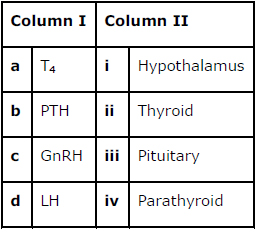
Answer

Answer
Comments
Post a Comment